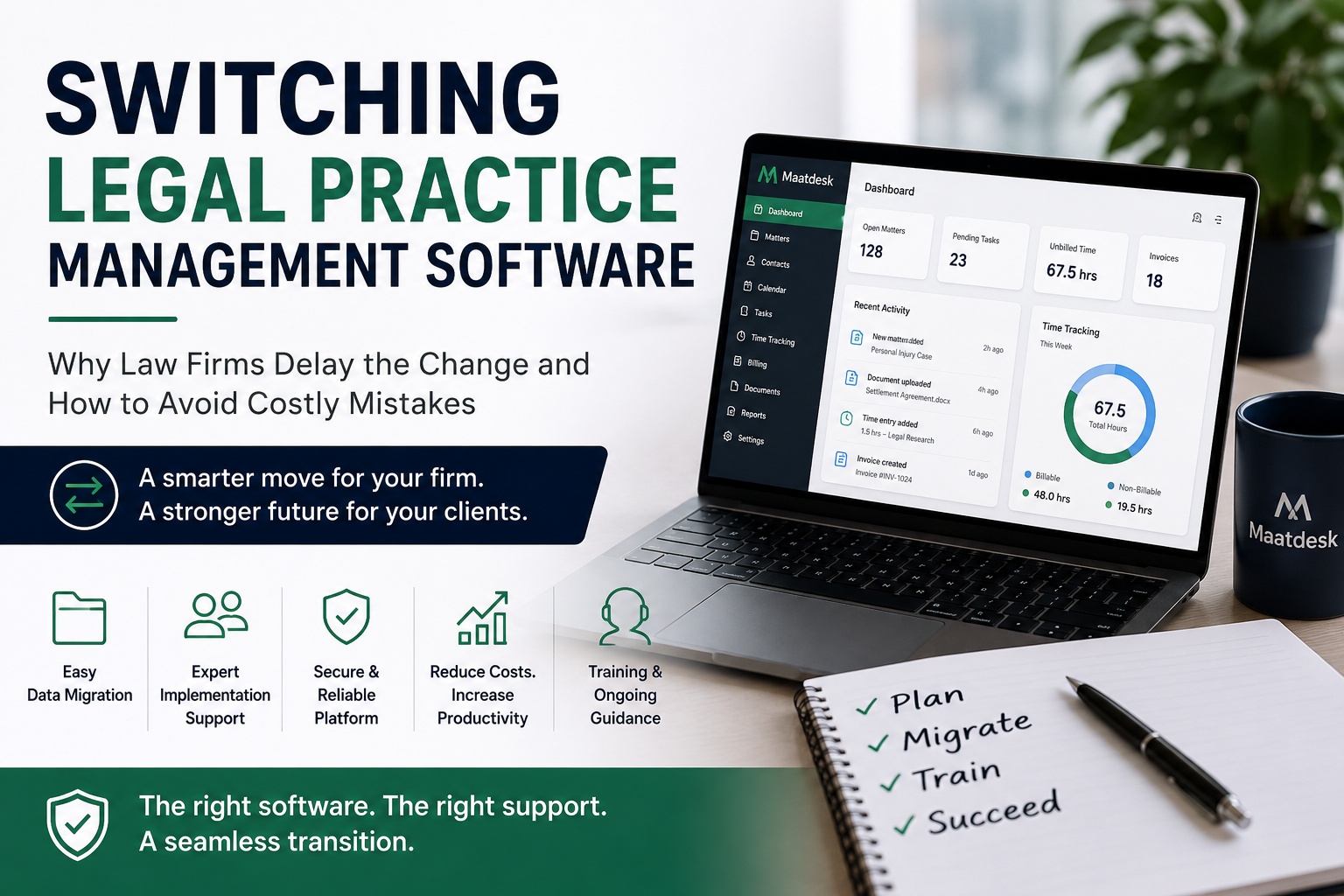
Switching Legal Practice Management Software
Thinking about changing legal software but worried about disruption? You are not alone. Many firms stay with outdated platforms longer than they should because switching feels risky.
But the right legal practice management software can improve productivity, reduce software costs, simplify operations, and support long-term growth.
This guide explains why law firms delay migrating, how to avoid common implementation mistakes, and what to look for when evaluating alternatives.
Quick Summary
- Migration is easier than most firms expect
- Staying with the wrong software has hidden costs
- Implementation support reduces downtime
- Modern platforms consolidate multiple subscriptions
Why Law Firms Delay Switching Legal Software
Attorneys adopt new legal technology every year, from e-signatures and cloud storage to AI-assisted drafting and client portals.
Yet many continue using software they no longer enjoy because changing systems feels overwhelming.
Common concerns include:
- Will existing cases migrate properly?
- Will documents and client records transfer?
- Will staff lose productivity?
- Will historical billing data remain intact?
- How difficult will training be?
- What happens if implementation fails?
These concerns are understandable. Law firms manage deadlines, trust accounting, confidential records, and operational workflows that cannot pause.
The Reality of Legal Software Migration
Modern legal software migration is far more structured than it was ten years ago.
Many legal software providers now offer onboarding specialists, implementation advisors, migration planning, workflow configuration, and guided training.
Successful migration is usually not a technology problem. It is a planning and communication process.
Firms that prepare early often experience faster adoption and fewer disruptions than expected.
The Hidden Cost of Keeping the Wrong Legal Practice Management Platform
Rising Subscription Costs
Pricing often increases over time while features move behind premium tiers.
Extra Charges for Standard Features
Electronic signatures, client communication tools, document storage, and automation frequently become additional purchases.
Productivity Loss
Staff spend hours completing tasks modern automation can finish in minutes.
Fragmented Systems
Multiple disconnected platforms increase operational complexity and software spend.
How to Successfully Switch Legal Practice Management Software
- Evaluate Existing Workflows
Identify bottlenecks and determine which processes should improve. - Prepare Data Early
Organize contacts, billing records, case files, and permissions. - Train Staff Before Launch
Create internal champions who help support adoption. - Use Implementation Support
Dedicated white-glove onboarding dramatically improves transition success.
What to Look for in Legal Practice Management Software
- Transparent pricing
- Included implementation services
- Staff onboarding and training
- Unlimited electronic signatures
- Cloud security and compliance
- Scalable infrastructure
- Migration assistance
Looking for a Clio Alternative, MyCase Alternative, or PracticePanther Alternative?
Many firms explore alternatives because of increasing costs, feature limitations, or the challenge of managing disconnected systems.
Maatdesk legal practice management software combines operations into one secure platform.
Why Law Firms Choose Maatdesk
- Case Management
- Time Tracking
- Billing & Invoicing
- Trust Accounting
- Document Management
- Client Portal
- AI Tools
- Unlimited E-Signatures
Every customer receives access to an Implementation Advisor for onboarding, migration planning, and staff training.
Frequently Asked Questions
How long does it take to switch legal practice management software?
The timeline depends on firm size, data requirements, and workflow complexity. With the right implementation support, many firms can reduce disruption during the transition.
Can legal case files be transferred to new software?
In most cases, yes. Case files, documents, contacts, billing records, and related information can often be migrated with proper planning and support.
Does Maatdesk help with migration and onboarding?
Yes. Maatdesk provides guided onboarding and data-migration assistance, with a dedicated account manager, virtual training, and live onboarding training.
Start Your Free 6-Month Trial
No credit card required. No long-term contracts.
Schedule Your Demo